

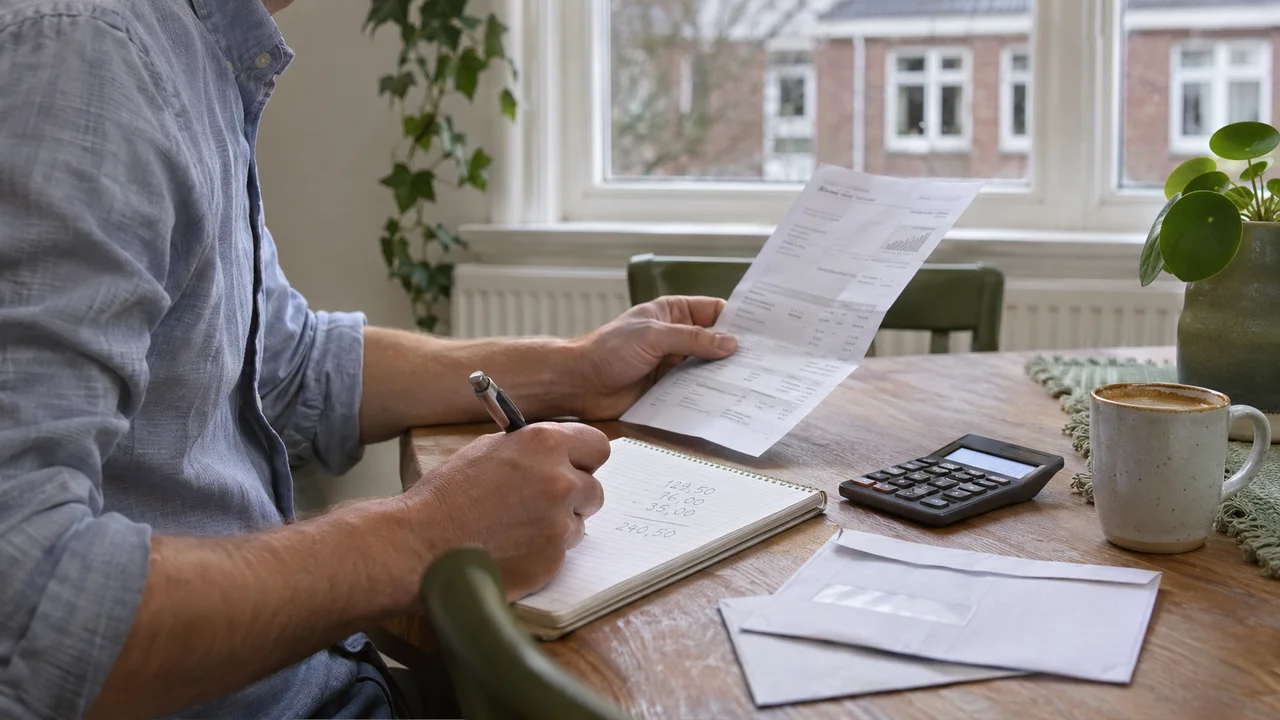
None of them are huge on their own, but together they make a real difference to your budget. This guide explains every cost, how utilities and local taxes work in the Netherlands, how to keep your bills low and what we arrange for you at check-in, so you can compare homes properly and never be caught off guard.
First, read the listing carefully: what "excl." really means
On Funda and Pararius, most rental prices exclude utilities. Look for these terms:
- Excl. (exclusief): rent only. You pay energy, water and internet yourself, which is the case for most listings.
- Incl. (inclusief): some or all utilities are included, often listed as g/w/e (gas, water, electricity). Check exactly what’s covered, and whether it’s a fixed amount or an advance that’s settled later.
- Service costs (servicekosten): sometimes listed separately, sometimes included in the rent.
When you compare two homes, always compare the total monthly cost, not just the rent.
Your monthly housing costs, line by line
Rent
The basic rent for the home itself.
Service costs (servicekosten)
Common in apartment buildings. They can cover cleaning and lighting of shared areas, a caretaker, the lift, or furniture in a furnished home. Your landlord must send you a yearly statement of the actual costs, so you may get money back, or pay a little extra.
Insurance
Two are worth having from day one: liability insurance (aansprakelijkheidsverzekering) and contents insurance (inboedelverzekering). Health insurance is separate and mandatory.
Bicycle insurance may also be worth considering if your bike is valuable.
Parking
If you have a car, check whether the street is in a paid parking zone and whether you need a permit. A parking permit is a separate cost to include in your monthly budget.
One-off costs when you move in
- Deposit: usually one to two months’ basic rent
- Furniture, if the home is bare or unfurnished
- Moving and transport costs
Utilities and local taxes come on top of these. We explain them below.
Why we look at energy costs before you rent
The energy label is a useful signal, but heating type, insulation and whether a property is a corner or end-of-terrace home matter too. Older Amsterdam and Utrecht homes can be drafty and expensive to heat, while a well-insulated new build in Almere or Amstelveen may cost far less to run at the same rent.
A low rent doesn’t always mean a cheap home. A drafty home with single glazing can cost far more to heat than a well-insulated one. That’s why, when we search for homes with our clients, we always look at the expected energy costs as well as the rent. The energy label is a good first indication: A and B labels usually mean lower bills, while labels E to G often mean higher heating costs. We help you compare the total monthly cost of each home, so you choose the one that really fits your budget.
Your utilities explained
Energy: electricity and heating
Usually your biggest variable cost. How much you use depends on the size of the home, its insulation and its energy label. Heating comes in three main forms:
- Gas: a boiler heats your home and water
- District heating (stadsverwarming): heat delivered through a city network, common in parts of Amsterdam and other cities, where you can’t choose your supplier
- Block heating (blokverwarming): one system for the whole building, usually paid through your service costs
Water
Supplied by your regional water company. You can’t choose the company, but it’s usually one of your smaller costs.
Internet and TV
Choose between fiber, cable or DSL, depending on what’s available at your address. Installation can take one to three weeks, so arrange it early.
How utilities work in the Netherlands
A few things often surprise newcomers:
- You choose your own energy supplier for electricity and gas, and can compare deals. The network operator in your area is fixed.
- You pay a monthly advance (voorschot), based on expected use. Once a year, you receive an annual bill (jaarafrekening) that settles the difference, so you may get money back or pay extra.
- Choose your monthly advance carefully. If it’s too low, the annual bill can come as a shock.
- When you move in, the meter readings are recorded, so you only pay for your own use.
- Canceling usually requires notice, so plan ahead when you move out.
Your move-in checklist for utilities
Before you move in
- Ask the landlord which utilities are included and which you arrange yourself
- Choose your energy supplier, if the home isn’t on district or block heating
- Order internet early, ideally two to three weeks before
On move-in day
- Record the meter readings for electricity, gas or heat, and water, with dated photos
- Check the heating, hot water, lights and sockets
- Find out which bins are for which waste, and the collection days
In your first weeks
- Register with the municipality and get your BSN
- Arrange liability and contents insurance
- Set up your monthly advance payments by direct debit
- Download your energy supplier’s app to track your usage and see what your monthly costs really are
- Check your usage after the first month and adjust your monthly advance if needed, so the annual bill doesn’t surprise you
We take care of this at check-in. For our clients, we record the meter readings, check that everything works and set up your energy, water and internet, so your home is ready from day one.
Yes, tenants pay local taxes too
In many countries, local property taxes are the owner’s problem. In the Netherlands, they’re split. The owner pays the property tax (OZB) on the building. But because you’re the one living there and using local services, some taxes are charged to you, the resident. They’re not included in your rent, and they apply whether you rent a studio or a family home.
The local tax bills to expect
Waste collection tax (afvalstoffenheffing)
Charged by your municipality for collecting and processing household waste. Most municipalities charge a fixed amount per year, with a lower rate for one-person households than for larger ones.
Water board tax (waterschapsbelasting)
The Netherlands sits largely below sea level, and regional water boards keep it dry and clean. As a resident, you pay two parts: a charge for treating wastewater, based on whether you live alone or with others, and a charge per household for managing dykes and water levels.
Sewage charge (rioolheffing)
In some municipalities, residents pay part of the cost of the sewer system. In others, only the owner pays it. Check your municipality’s website to see whether it applies to you.
The exact amounts differ per municipality and water board and change every year. Together, they usually add a few hundred euros a year to your housing costs. Check your municipality’s and water board’s websites for this year’s rates.
When the bills arrive and how to pay
Most local tax assessments arrive early in the year, often in February or March, covering the whole year. If you move in during the year, you usually receive a bill for the remaining months. Bills are sent by post or to your digital government mailbox (Berichtenbox on MijnOverheid). In many areas, a joint tax office sends one combined bill for the municipality and water board.
- Set up MijnOverheid as soon as you have your BSN and DigiD, so you don’t miss official letters
- Choose direct debit (automatische incasso) to spread payments over several months, which most tax offices allow
- Pay on time: reminders and collection costs add up quickly
- On a low income? You may be able to apply for remission (kwijtschelding)
- Moving to another municipality during the year? You may be able to get part of your waste tax back from your old municipality
Tips to keep your housing costs under control
- Track your usage in your supplier’s app. Seeing your daily use makes it much easier to spot what’s costing you money.
- Do as the Dutch do in winter: set your thermostat to around 18 degrees and put on a sweater. Every degree lower makes a noticeable difference to your heating bill.
- Check the energy label before you sign: a better label usually means lower energy bills
- Compare energy suppliers once a year
- Ask for last year’s service cost statement before you sign
- Set aside a little each month for local taxes and your annual energy bill
- Look at nearby areas: neighboring towns like Amstelveen, Haarlem or Leiden often offer more space for your budget
Questions to ask before you sign
- Which costs are included in the rent, and which are separate?
- What do the service costs cover, and can I see last year’s statement?
- What is the energy label, and how is the home heated?
- Are energy, water and internet in my name or the landlord’s?
Local taxes are almost never included, so assume you’ll pay them yourself.
Before you commit, ask for the last twelve months of utility costs and the service charge statement. If the answers are vague, treat the total monthly cost with caution.
Monthly budget checklist
Use this list when you compare homes:
- Rent
- Service costs
- Energy (advance)
- Water
- Internet
- Local taxes (monthly share)
- Insurance
- Total per month
Frequently asked questions
Want to know what a home will really cost you?
In a free 15-minute call, we’ll help you work out a realistic monthly budget for the city and area you have in mind, including every cost on top of the rent.
Book a free callThis guide is general information, not tax advice. Costs, tax rates and rules differ per city, home and supplier and change over time, so always check the details for your situation.